Mind the Gap: a pilgrimage to the Grand Canyon’s Great Unconformity


The Grand Canyon is one of the natural wonders of the world. Its mile-deep chasm slices through the heart of the American southwest, carrying the waters of North America’s seventh-largest river basin. Yet for most of its 300-mile length, the Grand Canyon is accessible only by foot, boat, or mule.[1]
For a geologist, visiting the Grand Canyon is an especially powerful experience. In a single place, the Canyon embodies some of the deepest and most profound concepts in geology. Above all, the Canyon speaks to the depths of time. The Canyon walls expose layer upon layer of rock. Together, these cliffs and slopes tell the story of a changing world—the gradual transformation of this particular place from one environment to another: a shallow tropical sea, a wind-swept desert, a vast river floodplain. And, ultimately, a high plateau carved open by the power of a river.
The Canyon’s most iconic piece of geology, however, isn’t about what’s present but what’s missing. A visitor standing on the South Rim will see a pile of nearly flat sedimentary rocks, the result of gradual accumulation of debris over hundreds of millions of years. This heap of stony pancakes sits on top of something that looks quite different: a chaotic mass of “basement” rock that is dark, twisted, baked, and injected with ancient magma. In the gap between these rock masses lies a story of missing time.
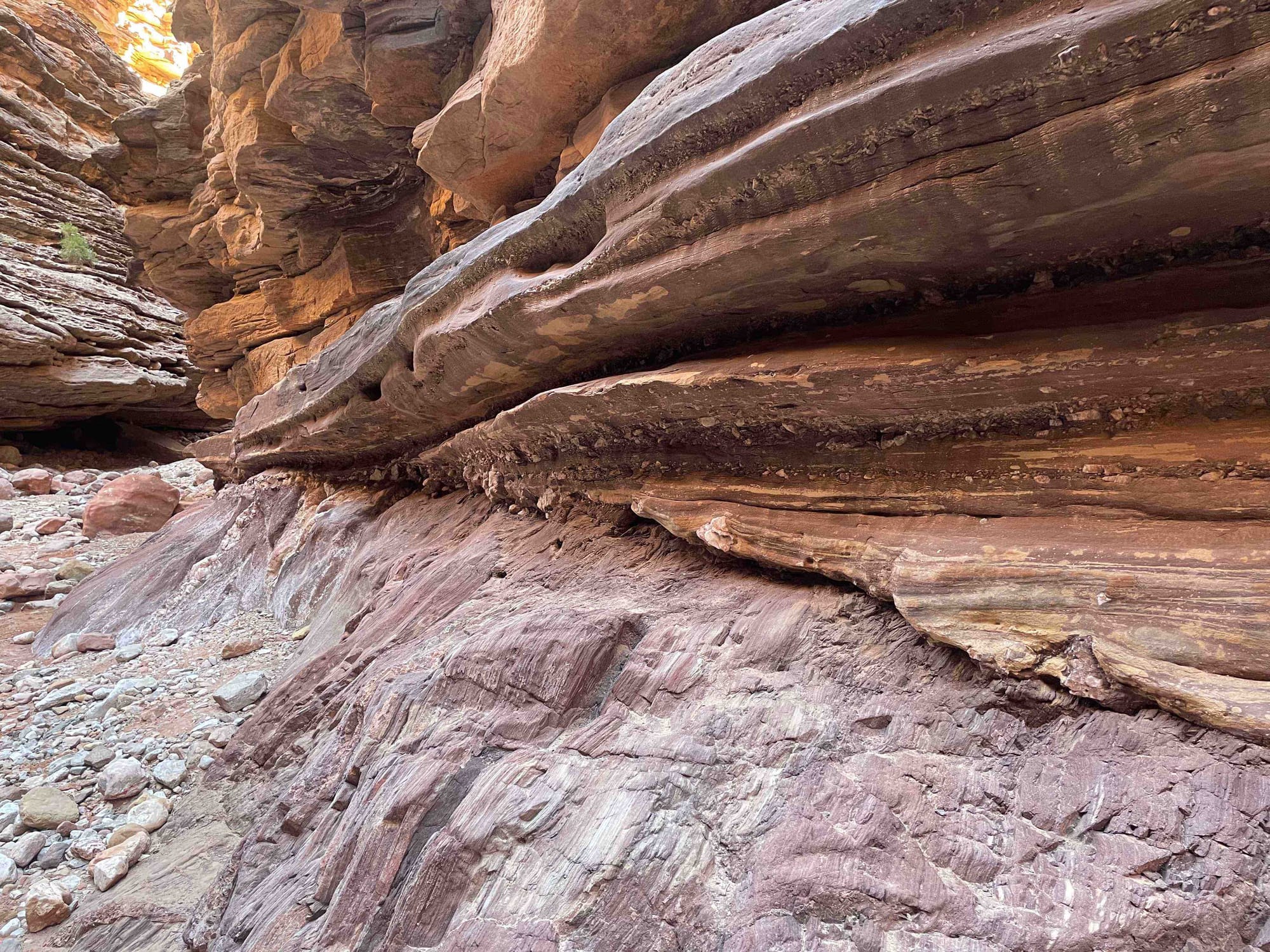
In May 2026, I had the good fortune to join a boat trip down the Colorado River through the Grand Canyon.[2] For me, the most profound stop was a little side gorge called Blacktail Canyon. The walls of Blacktail Canyon expose the seam where the sedimentary layers meet the dark crystalline rocks below. Under this seam lies the Vishnu Basement: a heap of deeply squeezed and cooked rocks that started out as sand and mud at the bottom of an ancient sea, and later became deeply buried, deformed, heated, and injected with jagged ribbons of molten rock.
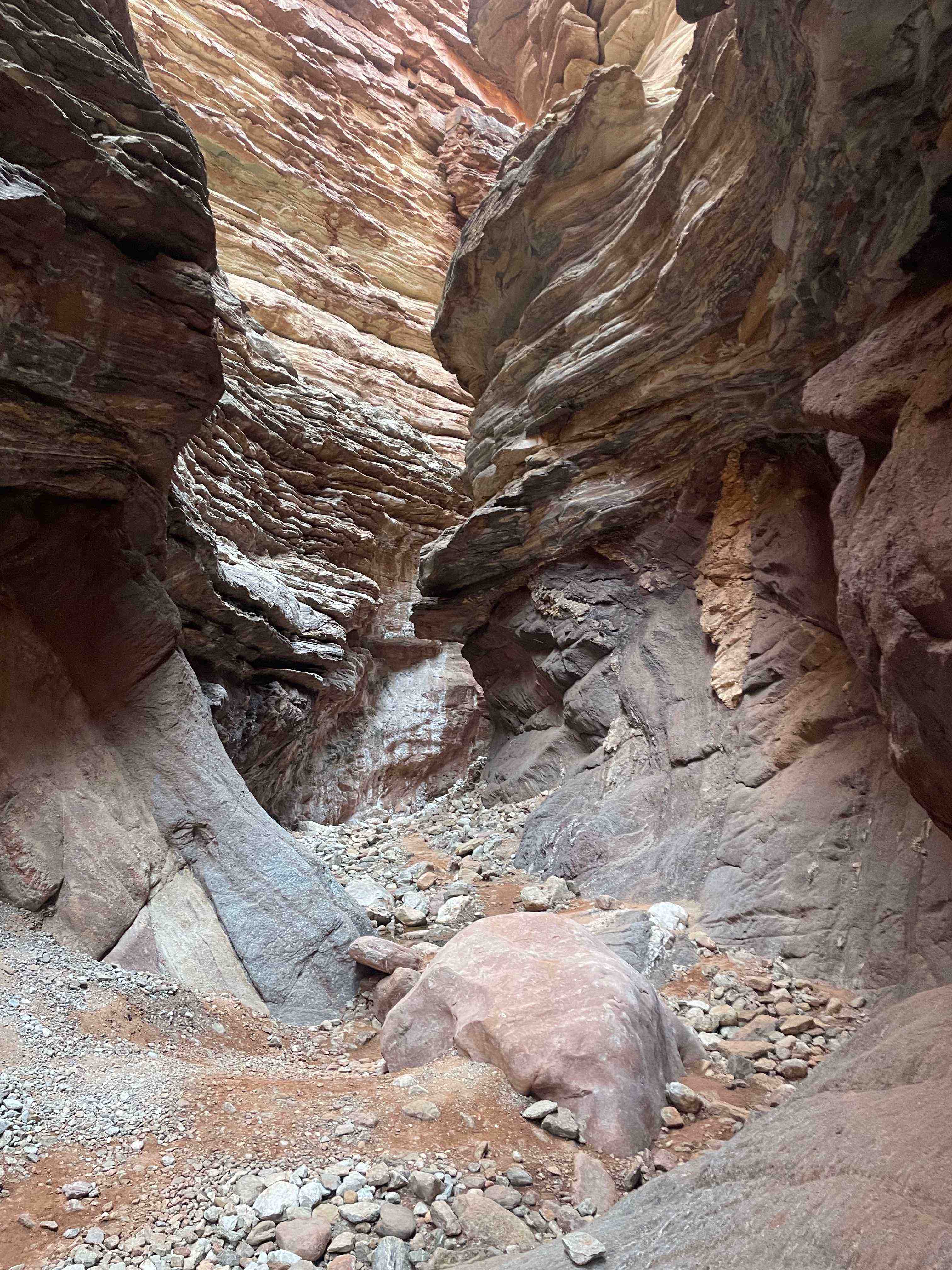
The Vishnu Basement is about 1,750,000,000 years old.[3] Its metamorphosis took place at a time when life on earth was entirely microbial, a time when earth’s fast spin meant that each passing day lasted a mere 20 hours.[4] On top of the Vishnu sits a layer called the Tapeats Sandstone. Its sand grains were once tossed around by waves and tides, but now they have long since been cemented into stone. Fossils and other clues inside the Tapeats reveal that its sand layers were deposited along a shoreline that existed a mere 500,000,000 years ago.
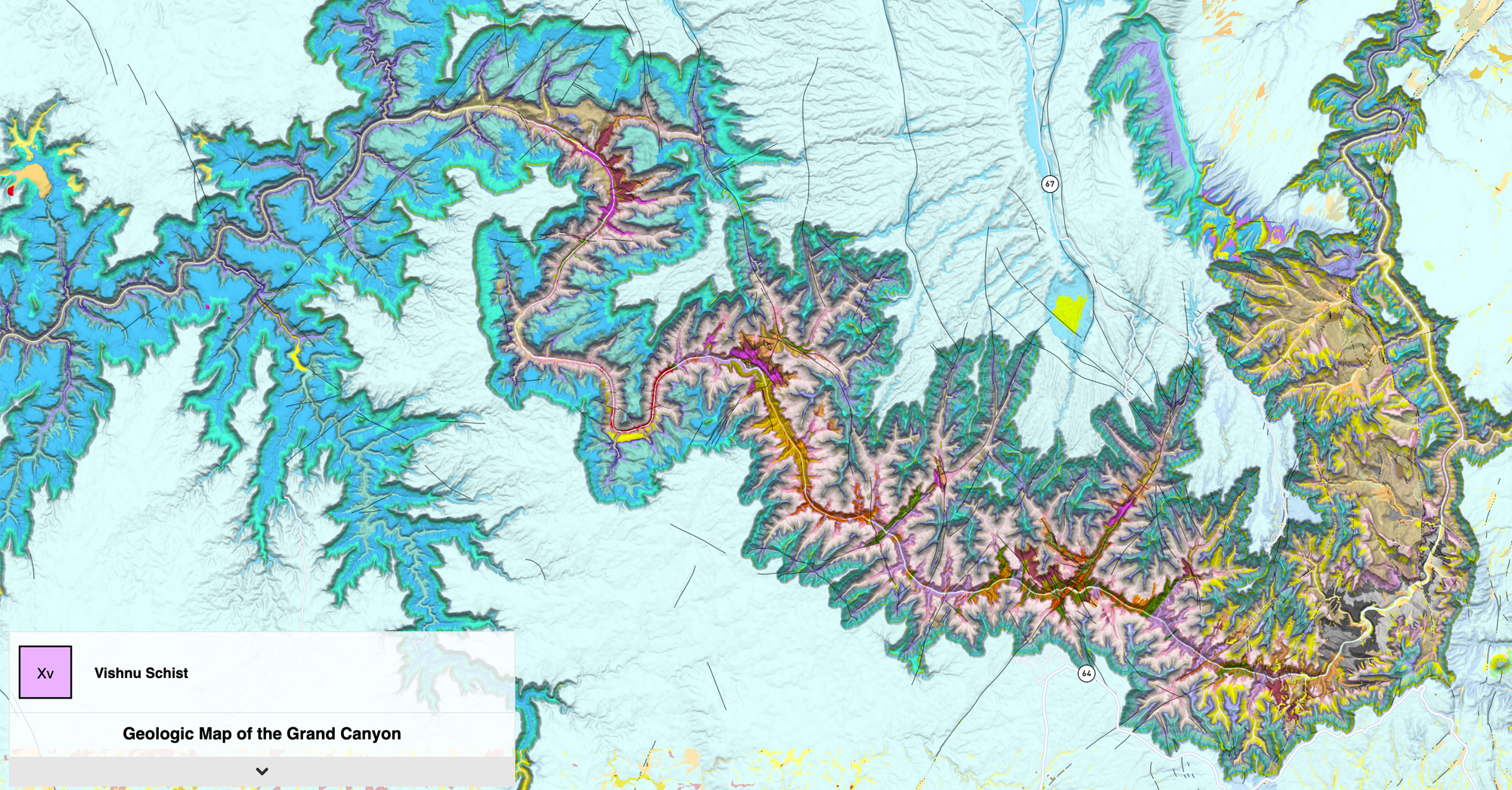
The contact between Vishnu and Tapeats is known as the Great Unconformity. It represents the missing time between the formation of the Vishnu Basement and the arrival of the first sand grains to settle and endure on its eroded surface. The top of the Vishnu represents an ancient land surface — a surface that sat buried under layers of debris for half a billion years until the Colorado River exposed it to view again.
If you’re not familiar with the concept of an unconformity, here’s an analogy. Suppose it snows on Monday and then again on Tuesday. But on Wednesday, the sun comes out and melts Tuesday’s layer of snow. Then Thursday brings another snow storm. The net result is two layers of snow: one from Monday and one from Thursday. In between is a two-day gap in time, an unconformity in the snow. It isn’t that nothing happened on Tuesday or Wednesday. It’s just that Wednesday’s melt destroyed the record of Tuesday’s snowfall.[5]
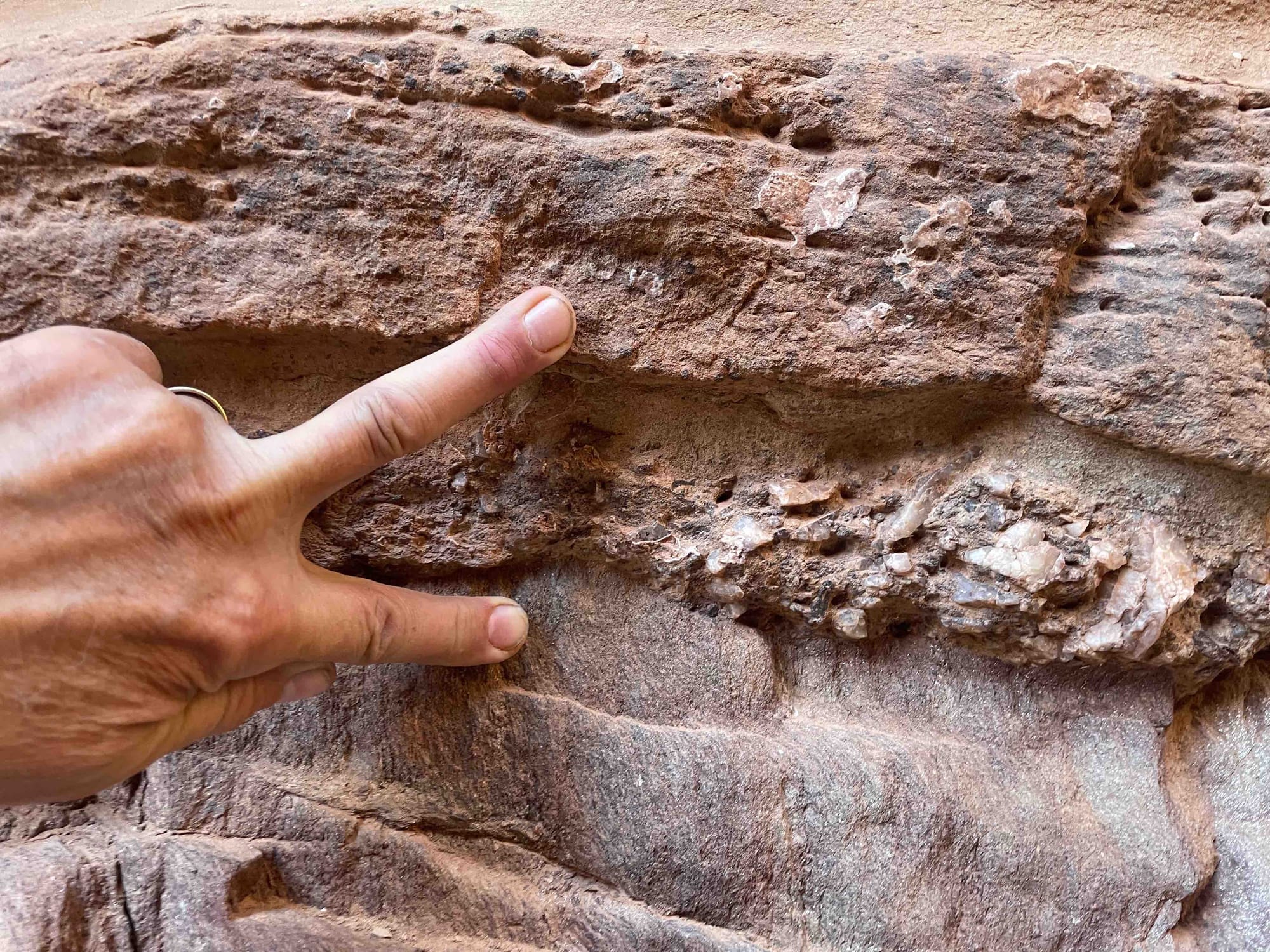
At Blacktail Canyon, the Great Unconformity spans roughly 1.25 billion years. That adds up to 28% of earth's four-and-a-half billion-year history. In other words, at Blacktail Canyon you can bracket more than a quarter of all geologic time in the span of just two fingers.
Sites like Blacktail Canyon convey a quietly magnificent story: just by virtue of living on planet earth, all of us belong to something bigger and deeper than ourselves. [6]
[1] That fact is a testament to the work of what was, in the 1950s, a small hiking club based in California. The Sierra Club fought hard to keep the Canyon and other iconic places as pristine as possible; in the process, they grew into one of America’s biggest environmental organizations.
[2] I am deeply grateful to Lon Abbott and Terri Cook for organizing this trip. They literally wrote the book on hiking the Grand Canyon’s geology.
[3] I am simplifying things a bit here. Vishnu Basement Rock, also known as the Vishnu Complex (which sounds to me like a psychiatric disorder), is a general name for the metamorphic and igneous rocks of early Proterozoic age that are exposed in the Canyon. The National Park Service has a nice description of the Canyon’s basement rocks at https://www.nps.gov/articles/000/grcatime-vishnu-basement-rocks.htm.
[4] I often feel that 24-hour days are already too short, so I’m glad not to be living in the Paleoproterozoic Era. I also appreciate the abundant breathable oxygen of our current geologic era.
[5] Admittedly, this analogy might be hard to imagine on a hot August day in the northern hemisphere.
[6] You don’t actually have to travel to the bottom of Granite Gorge to experience the Great Unconformity. A time-gap between basement rocks of Precambrian age (representing the 8/9ths of earth's history that played out before the first appearance of macroscopic, hard-shelled fossils) and sedimentary rocks from the eon of visible life (the last ~500 million years) can be found in many places across the continents. For example, residents of Denver and other towns along the eastern edge of the Colorado Rockies can cross the Great Unconformity just by heading west into the Front Range along one of its many beautiful canyons.